
As one of the largest powersports dealership groups in Southern California, Del Amo Motorsports manages a large operational footprint with expansive showrooms, service departments, warehouses, and outdoor inventory yards across eight dealership locations. For Rick Rivetti, CIO and CISO, that created a clear challenge: protect people, inventory, and operations with a system that was scalable, measurable, and easy to manage across every site.
“For us, Verkada represented a clear shift from legacy surveillance to intelligent automated physical security.”
Key stats
8 large dealership locations across Southern California
3 disconnected legacy systems consolidated into one platform
4 minutes: how quickly after-hours trespassing incidents can occur without proactive deterrence
~8 minutes: rapid law enforcement response when a known fraud suspect appeared at another store
The challenge: disconnected systems and reactive security
Before Verkada, Del Amo Motorsports relied on three separate systems to cover one security problem: legacy building alarms, indoor video surveillance with on-prem NVRs, and a separate outdoor remote guarding solution. Each worked in its own silo. The result was limited visibility, slow escalation, and an operation that depended too heavily on manual oversight. In some cases, after-hours incidents were not discovered until the next day, highlighting the limitations of reactive, siloed security models.
Outdoor security presented an even bigger challenge. Traditional alarm hardware could help protect doors and indoor motion zones, but it could not effectively cover vehicle lots, fence lines, and open-air inventory yards. If something happened outside, monitoring workflows lacked continuity across exterior and interior environments. From Rick’s perspective as both CIO and CISO, the old model also created governance problems: vendor-controlled configurations, networking complexity, ongoing hardware maintenance, and added attack surface from legacy systems.
Why Del Amo chose Verkada
In 2025, Del Amo standardized its physical security stack on Verkada. Rick was looking for more than cameras. He wanted one cloud-managed platform with centralized policy control, strong cybersecurity hygiene, simpler infrastructure, and the flexibility to standardize security operations across all stores. Verkada stood out for its architecture, rapid innovation, and ability to consolidate cameras, alarms, alerting, monitoring, and deterrence into a single system Del Amo’s team could fully own and manage.
That mattered operationally, but it mattered just as much strategically. Rick wanted physical security to align with the same standards Del Amo applies across the rest of its enterprise environment: role-based access, automatic updates, encrypted traffic, centralized administration, and fewer legacy maintenance burdens. According to Rick, Del Amo’s total cost of ownership was also significantly lower than continuing to run all three legacy systems in parallel.
How Del Amo uses AI-powered deterrence
Today, AI-powered deterrence is one of Del Amo’s most important tools for preventing loss before damage is done. Verkada’s AI-powered deterrence uses cameras to detect activity such as person detection, loitering, or line-crossing in defined zones, then delivers escalating, scene-aware voice warnings through speakers or intercoms. If the person ignores repeated warnings, the workflow can escalate into an alarm. In short: early detection combined with escalating deterrence.
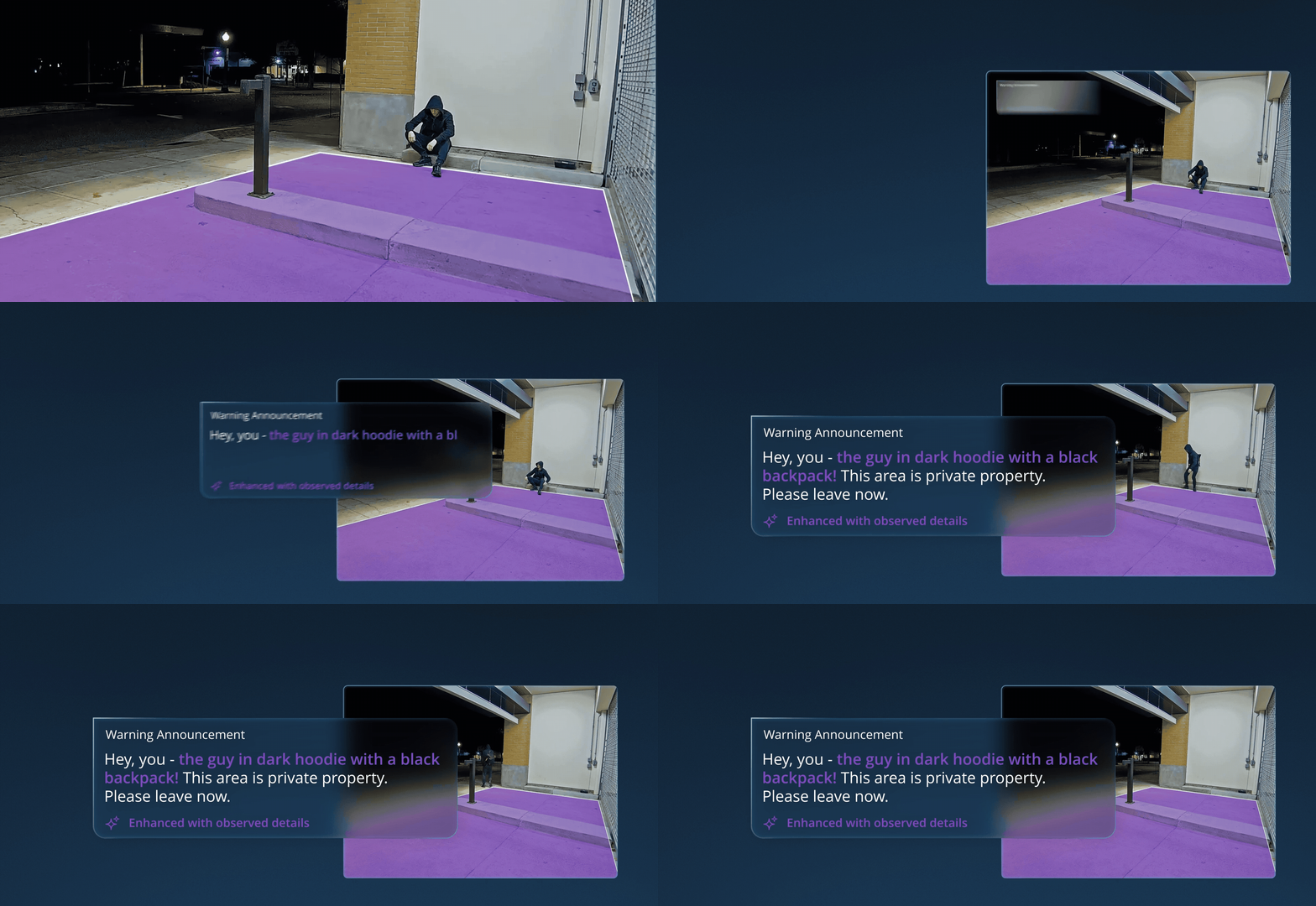
At Del Amo, Rick’s team applies that model in a layered way. Exterior deterrence zones warn people early in an unauthorized approach. If they continue toward a more sensitive area, the system escalates to an alarm and coordinated response. That lets Del Amo deter suspicious behavior at the perimeter instead of waiting for an incident to escalate. Rick described the approach simply: “Think of it from the outside in. It starts with deterrence… and if you get closer and ignore it, it’s immediate dispatch.”
For Del Amo’s outdoor inventory yards, that difference is critical. Traditional indoor-focused alarms do not work well in open exterior spaces, but Verkada cameras do. Rick described these lots as exactly the kind of environment where the business needed earlier detection and faster response. When someone crosses into a protected area after hours, Del Amo’s system can warn them immediately, and if they keep going, the response becomes decisive. As Rick put it, “Most of the time, people will not want to mess with us because of that feature alone.”
Beyond deterrence: better visibility across every store
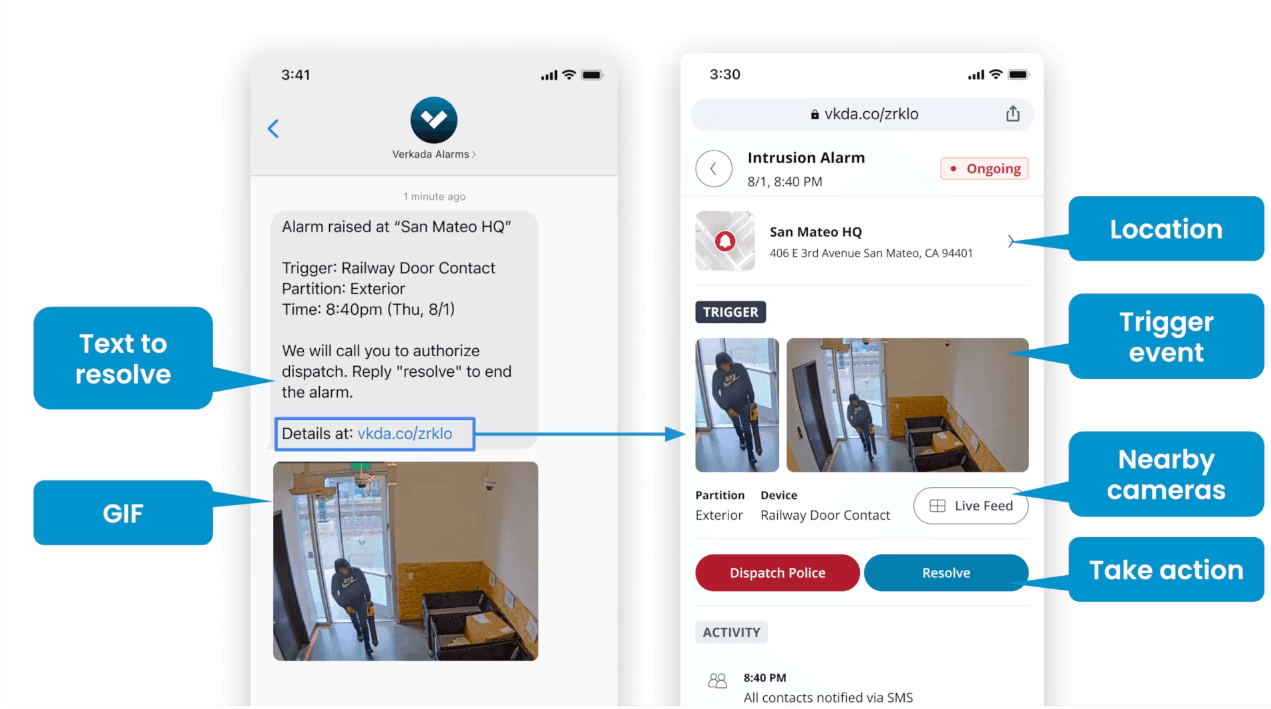
Del Amo also uses Verkada well beyond core video surveillance. The team relies heavily on customizable alerts, remote arming and disarming through the mobile app, person and vehicle-based analytics, and 24/7 monitoring. Managers receive arm/disarm confirmations, employees can manage alarms remotely, and teams can configure alerts based on vehicles, motion, restricted areas, and other site-specific conditions.
Rick also highlighted how Del Amo uses AI-powered identification and alerting to track repeat activity across locations. In one case, the team created an alert profile based on prior activity after an attempted incident at one store. When that same person showed up at another location and attempted similar fraud, Del Amo received an alert, confirmed the situation, and law enforcement responded quickly. In another case, when a repeat theft suspect altered his behavior to avoid identification, the team used a vehicle loitering alert tied to his recurring parking pattern to identify him before he could act. Together, those examples show how Del Amo combines person-based alerts, behavioral triggers, and AI-powered deterrence to focus on the events that matter most. More broadly, capabilities like compound alerts make these workflows even more precise by allowing teams to notify only on combinations of signals, such as loitering from a known profile.

Faster adoption, less friction
From an implementation standpoint, Del Amo found the rollout straightforward. Because the business already had strong network infrastructure and PoE capacity, the team was able to deploy quickly. Adoption was also easier than expected: store managers learned the platform with minimal training, created their own camera grids, set their own alerts, archived incidents, and shared footage with authorities when needed. That ease of use helped shift security from a heavily centralized burden to a more scalable operating model across the business.
The result: a move from reaction to prevention
For Del Amo Motorsports, the biggest change is not just better video. It is a different security posture entirely. Instead of discovering incidents after the fact, the team can now detect suspicious activity sooner, warn unauthorized individuals in real time, and escalate when needed. Instead of stitching together three different systems, Del Amo manages one platform across a large dealership footprint. Instead of relying on reactive alarms alone, Rick’s team now has a practical way to protect outdoor inventory and deter unwanted activity before loss occurs.
For Rick, that is what modern physical security should look like: centralized, intelligent, and built to help the business prevent loss, not just review it afterward. “If you value a real path forward to prevention, not just reaction, Verkada is worth serious consideration.”