What’s the Difference Between a Cloud vs. Hybrid Cloud Security Camera System?

What are Cloud Security Camera Systems?
With the rise of IoT in recent years, many enterprises, hospitals, schools, and other multi-location organizations have considered the benefits of shifting their video surveillance security system to the cloud.
Cloud security systems consist of surveillance system cameras that stream network video directly to the cloud with the major advantage of being able to remotely view footage from any device. In addition, computationally challenging tasks can be done in the cloud to improve camera security, efficiency, and ROI. However, this wireless security system architecture presents several drawbacks.
Uncertainty regarding what happens to the surveillance cameras footage when there’s an internet outage.
Insufficient network bandwidth for multiple indoor and outdoor security cameras streaming 1080p hd video simultaneously.
Inability to comply with IP security and regulations like the PCI Standard and other governmental statutes, which require at least 90 days of video retention locally and in a separate hard drives backup location.
Concerns about the effectiveness of the video surveillance system’s overall security.
How is a Hybrid Cloud Security Camera System Different?
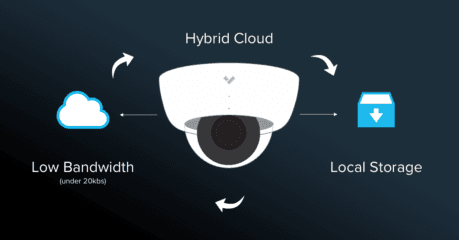
Unlike a typical wireless security camera system, a hybrid cloud security camera system consists of an on-site video surveillance storage solution as well as one located in the cloud. This hybrid PoE security infrastructure allows the system to address many of the difficulties IT departments and physical security teams have experienced with a pure cloud video surveillance security system.
Verkada: Enterprise Cameras Backed by Hybrid Cloud Architecture
All Verkada cameras come with up to 120 days of in-built video storage and processing power. In the case of an internet outage, the PoE cameras can keep recording and super hd footage can be viewed locally on the network. When internet access is restored, the footage in question is uploaded to the cloud (AWS).
The majority footage of IP cameras is motionless. A hybrid cloud architecture enables PoE security camera systems such as Verkada to send encrypted outbound metadata and short video clips, at less than 20 kbps every minute. When the PoE cameras detect motion, they can send these video clips more frequently. A streaming channel at higher bandwidth is opened only when an end user wants to remotely stream a PoE security camera feed. This intelligent bandwidth management allows indoor and outdoor security cameras to work flawlessly on any network, regardless of bandwidth limitations or the number of PoE video cameras installed.
Finally, the question of cyber security is fraught with controversy. While an air-gapped NVR security system is technically the most secure solution, it also presents many operational limitations that defeat the original intended purpose of keeping an organization safe. As soon as channel NVR ports are opened or forwarded for remote access, the NVR becomes one of the most dangerous technologies that exist. With a hybrid cloud security camera system like Verkada’s, the vendor (not the organization’s IT department) is responsible for the cyber security of individual IP cameras as well as the video surveillance system as a whole. Auto-updating PoE IP camera software and proactively patching firmware to the Powered over Ethernet camera enable Verkada’s systems to remain as secure as possible. Encrypted in transit and at-rest also ensures that the footage cannot be stolen locally, further minimizing cyber security exposure.
Side-by-side feature lists can only provide a limited view of how a cloud and hybrid cloud security camera system compare. Taking a contextual look at the architecture of these systems can demonstrate how hybrid cloud surveillance solves a series of deep-rooted constraints in the video security space—helping to reveal new benefits, updated workflows, and more seamless administration.
—
Want to learn more about the hybrid cloud security camera system? Check out our latest eBook, The Future of Enterprise Video Surveillance: The Shift from Traditional to Hybrid Cloud Security Systems.