What 2,741 IT and Security Leaders Across the World Told Us About Where Physical Security is Heading
The physical security industry has spent years debating where the system should live: on-premise or in the cloud. It was an important discussion with real tradeoffs, and it consumed a lot of budget cycles and a lot of conference panels.
That debate now appears to be settled. Only 8% of organizations report running physical security entirely on-premise, and among those not already fully cloud-managed, 94% are either planning a transition or already in one. Few have finished the move, though; most organizations still run a mix of cloud and on-premise.
What's ahead is AI: which capabilities to deploy, how to govern them, and how to prove they work. These are more nuanced questions than the cloud one ever was, because the answers change depending on what has already been built. But infrastructure hasn't stopped mattering: organizations further along in their move to the cloud report higher AI adoption.
The 2026 State of Cloud Physical Security report, conducted by Dynata on behalf of Verkada between March 30 and April 17, 2026, surveyed IT and physical security leaders across 10 markets. Here are some of the global findings.
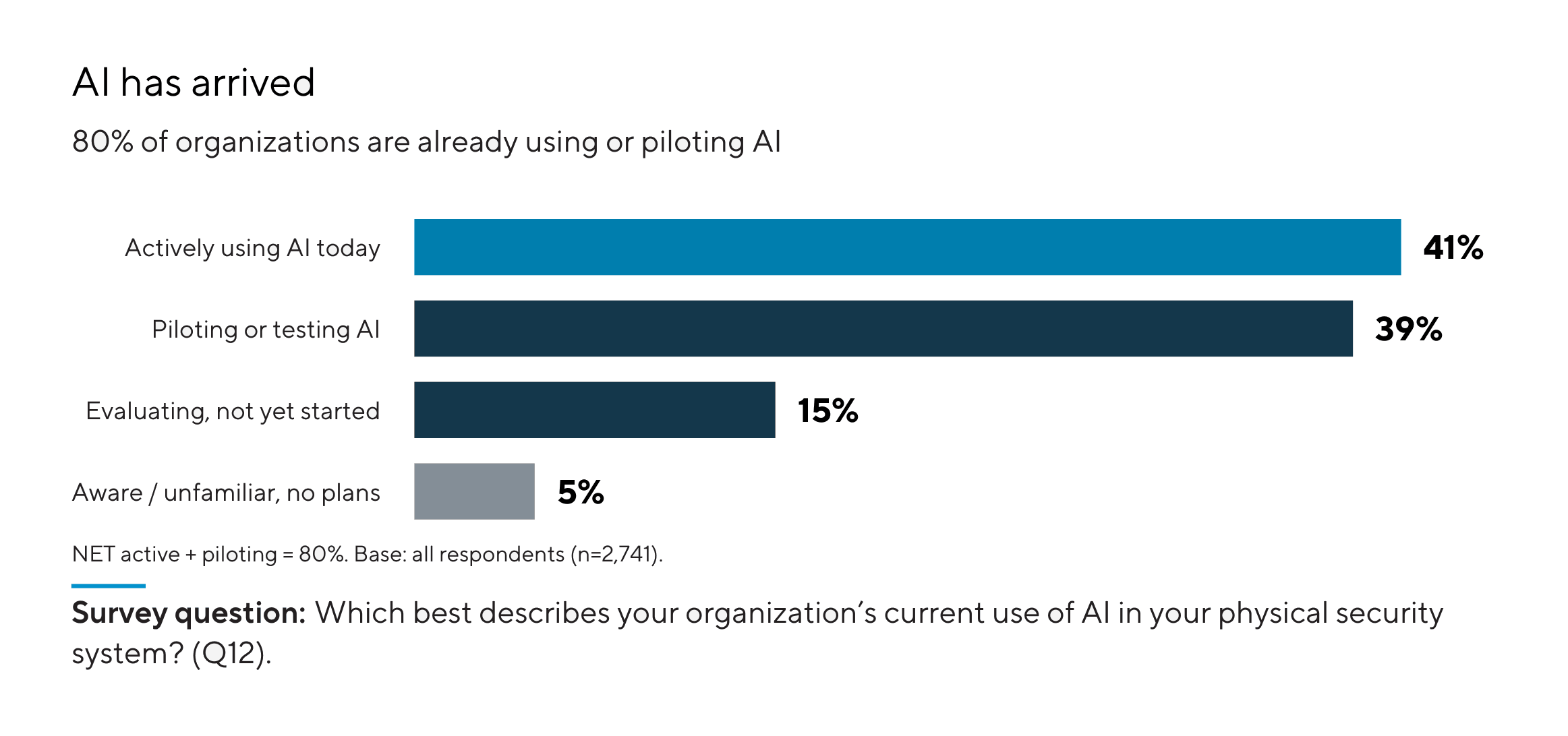
80% of organizations have started with AI. Only 41% are beyond the pilot stage.
Globally, 80% of organizations report either actively using AI features in physical security or piloting them (41% actively using, 39% piloting or testing) while 20% haven't started.
Among those who report using or piloting AI, AI-verified alarm monitoring is used by 55%, AI-generated incident summaries by 53%, and real-time motion, loitering, or line-crossing detection by 47%.
Cloud-managed organizations run AI at 2.6 times the rate
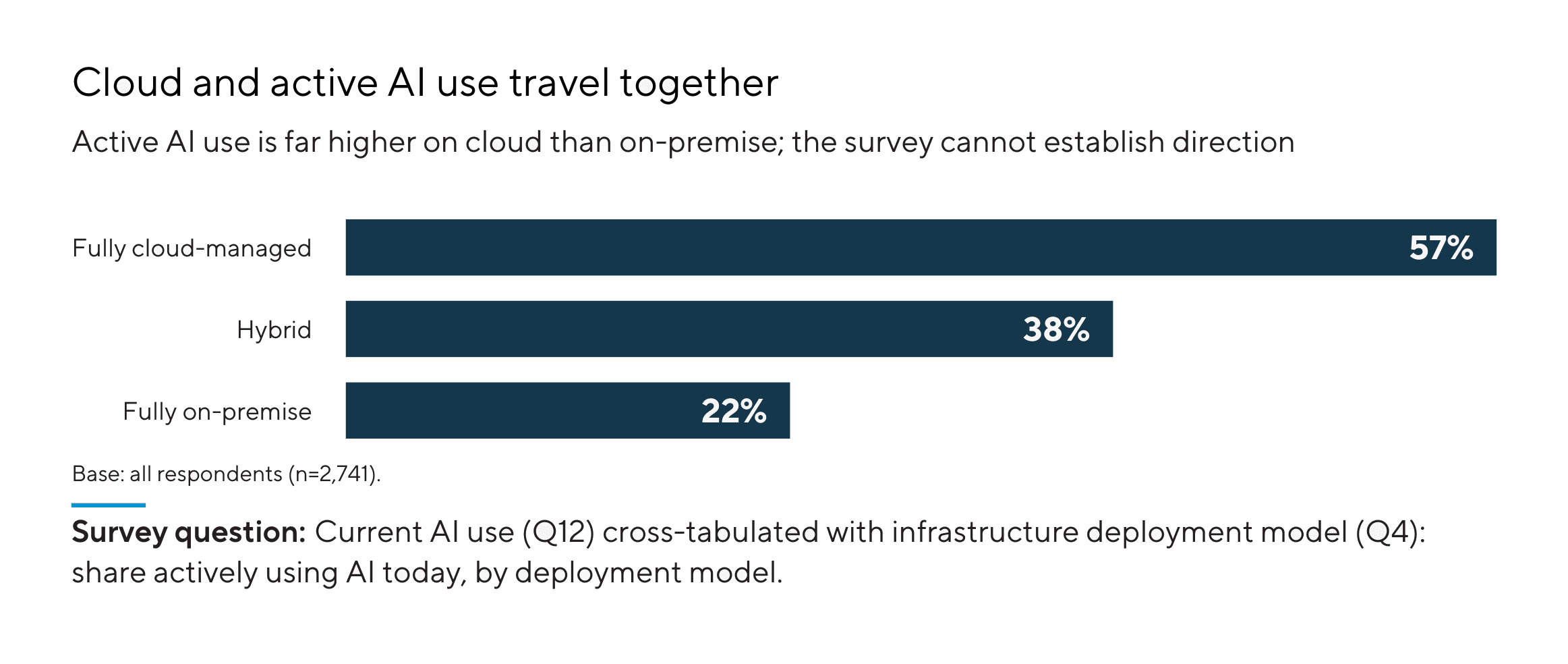
Fully cloud-managed organizations actively use AI at 2.6 times the rate of fully on-premise ones: 57% of fully cloud-managed organizations report they actively use AI compared to 22% of those with on-premise systems. Hybrid organizations are in between the two, with 38% reporting they actively use AI. While the survey can’t show that one causes the other, what it does show is a consistent ordering: fully on-premise organizations have the lowest AI adoption rates, whether the comparison is with hybrid or with fully cloud-managed. Cloud-managed organizations in this sample also run more sites and report faster-growing security budgets, either of which could contribute to the difference.
Our hypothesis here is that architecture matters. With on-premise systems, compute is fixed the day the hardware is purchased. New capabilities are only unlocked after site visits and upgrade cycles. For cloud-managed systems, the heaviest analysis happens where compute scales (in the cloud) instead of on the device, so new AI features arrive as software. This means piloting a new AI capability is de-risked: it’s simply a setting to turn on rather than a project to fund.
Nine in ten organizations use or plan to use insights from video security cameras for more than security
Across all organizations, workplace safety and compliance monitoring leads at 66%, followed by operational efficiency at 58%. Space utilization and insurance documentation and claims both sit at 40%, and retail analytics at 37%.
68% of organizations actively using AI report governance in place. Just 28% of those piloting do.
Across all 2,741 respondents, 41% report comprehensive AI governance covering physical security (written policies specific to how AI is used in these systems, not a general corporate AI policy), and 38% report formal, quantified return on investment (ROI), meaning a measured financial result rather than an estimate.
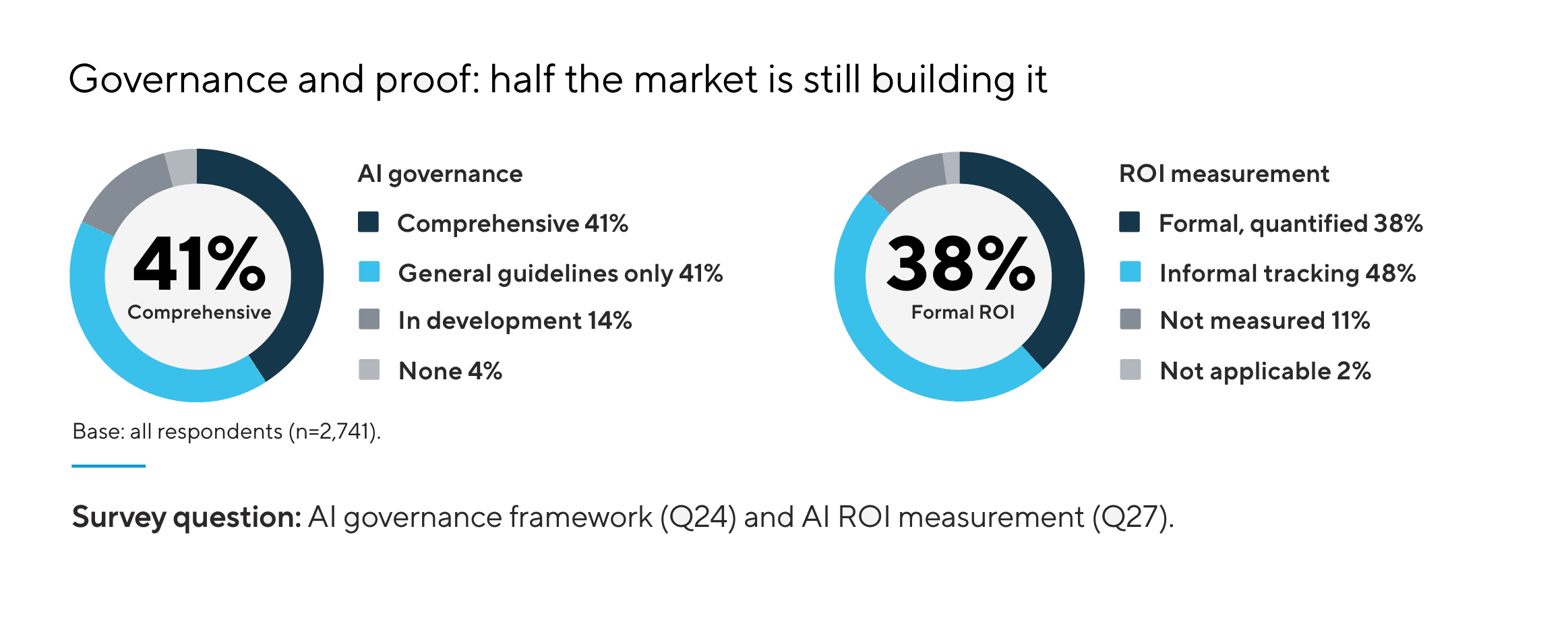
However, that 41% spans organizations at very different stages of AI adoption. Among organizations actively using AI, 68% report comprehensive governance. Among those still piloting, just 28% do (and among those that haven't started, 11% do). Governance is concentrated among the organizations already running AI in production, and formal ROI measurement tracks the same stages.
While these are differences between groups measured at one point in time, not steps in a sequence, the takeaway is clear: a policy and a baseline are easier to put in place during a pilot than after the program has been scaled up.
Three moves the data supports
Sequence infrastructure first. Cloud-managed organizations actively use AI at 2.6 times the rate of on-premise organizations. If you haven’t already migrated systems into the cloud, start with a few sites and pilot AI there.
Set baseline measurements and governance during the pilot. About two-thirds of organizations actively using AI report comprehensive governance, against about a quarter of those still piloting. To set your organization up for success in the long term, write physical security-specific AI policies and measurement plans before you scale.
Look for budget co-sponsors outside the security team. Nine in ten organizations use or plan to use video security camera data beyond security use cases. While the survey doesn't measure who funds these systems, the data shows a clear path to partnering with other parts of an organization for a more holistic, integrated approach to AI investments.
Get the full report
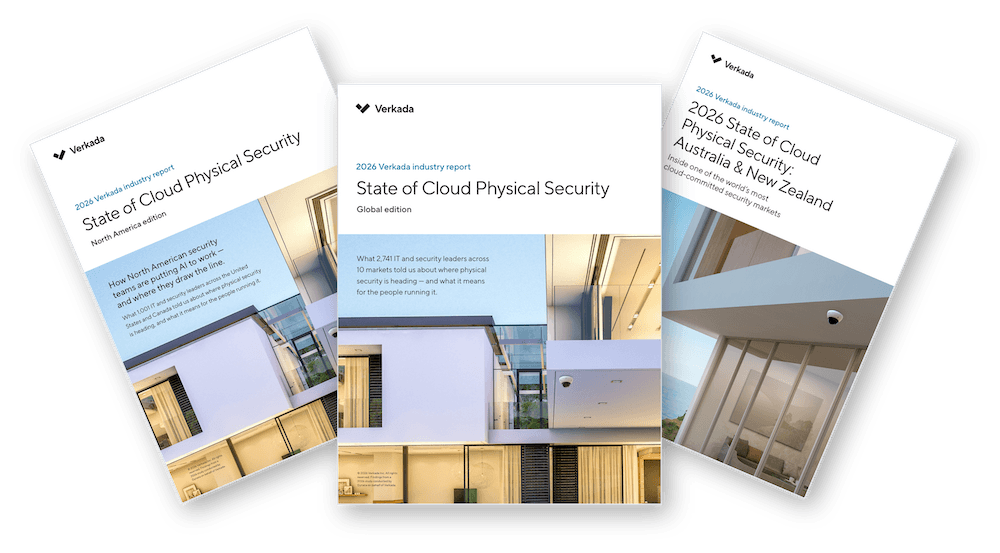
The 2026 State of Cloud Physical Security report covers all 10 markets, with the complete feature rankings, the governance and ROI split by stage of adoption, the capabilities leaders expect to matter most over the next two years, regional regulatory detail, and dedicated editions for North America, Australia & New Zealand, Europe, and Asia editions (available now). Download your copy to see how your organization compares.
About the research: the report draws on a study conducted by Dynata on behalf of Verkada, surveying 2,741 IT and physical security leaders across 13 countries grouped into 10 reporting markets, including 1,001 in the United States and Canada.
Respondents come from organizations with 100 or more employees and are involved in physical security decisions. Fieldwork ran March 30 to April 17, 2026. The 94% transition figure is based on organizations that are not already fully cloud-managed (n=2,138). All figures are self-reported and reflect what respondents told us about their own organizations, not independently measured outcomes.
Percentages are rounded to the nearest whole number, so shares of a single question may not sum to 100%. The architectural explanation of why cloud and AI adoption move together is Verkada's, not a finding of the survey.


