4K Security Cameras: Are They Worth It? Resolution, Storage, and Costs Explained
4K security cameras deliver 8 megapixel (8MP) resolution at 3840 by 2160 pixels, capturing approximately four times more visual information than standard 1080p cameras. This enhanced resolution is designed to support detailed identification of faces, license plates, and objects from greater distances and allows for significant digital zoom while maintaining higher image integrity than lower-resolution alternatives. However, 4K systems typically involve substantially more storage capacity, greater network bandwidth, and higher upfront costs than traditional cameras, making them practical primarily for large facilities or high-value environments.
What is a 4K security camera?
4K resolution represents the highest mainstream standard for security cameras, though some specialized systems exceed this capability. The 4K designation originates from theatrical projection systems and roughly indicates 4,000 pixels in the horizontal dimension. In security camera specifications, 4K and 8MP are functionally equivalent — both represent 3840 by 2160 pixel resolution totaling approximately 8.3 million pixels per frame.
This substantial pixel count transforms security video from overview-level detection to higher-fidelity capture. Operators can zoom digitally into recorded footage and potentially observe details that may be less clear in lower-resolution systems. A 4K camera covering a large parking lot may capture sufficient plate detail for facial identification throughout the recorded area.
4K resolution vs. 1080p vs. 5MP
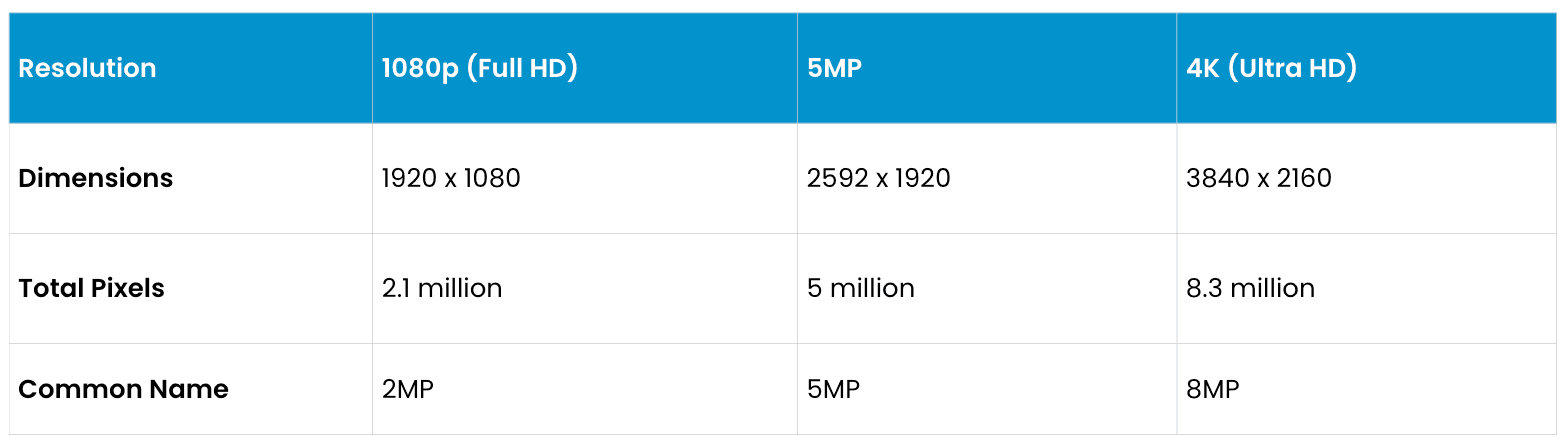
The differences are apparent in specific scenarios. A 1080p camera covering a 100-foot-wide parking lot produces video where vehicle details are barely distinguishable. The same scene captured in 4K reveals license plate characters, facial features, and vehicle damage clearly.
5MP cameras offer improvements over 1080p at roughly half the storage cost of 4K systems. Many organizations may find 5MP adequate for operational monitoring while preserving storage efficiency.
What does 4K actually look like?
Observing 4K footage reveals the dramatic difference from lower resolutions. On 4K monitors, 4K footage displays crisp, clear images where small details can remain identifiable throughout the frame. Digital zoom can maintain acceptable clarity at 2x or 3x magnification compared to 1080p.
However, observing 4K footage on standard 1080p displays can defeat much of the value proposition. Facilities should deploy appropriate display infrastructure — 4K monitors or large-format screens — to realize the quality benefits of 4K cameras.
At 100-foot distances, 4K cameras can capture license plate characters readable by standard OCR software, while 1080p at equivalent distances tend to produces characters too small for reliable recognition.
Advantages of 4K security cameras
Better digital zoom and forensic detail
4K resolution enables 2x or 3x digital zoom while maintaining acceptable image clarity. A suspicious person captured in 4K can be zoomed to reveal facial details, distinctive clothing patterns, or identifying marks. A single 4K camera may, in some configurations, cover the area of multiple lower-resolution cameras by capturing sufficient detail across a wide area.
OCR software for license plate recognition requires minimum character height for reliable results. 4K cameras can achieve reliable OCR from much greater distances than lower resolutions.
Wider coverage with fewer cameras
4K resolution enables wide-area cameras that can help capture sufficient detail for forensic examination. A single 4K wide-angle camera may cover the same area as three lower-resolution narrow cameras. This consolidation reduces installation labor and network infrastructure requirements.
Future-proofing your security system
4K represents current mainstream capability and is becoming a common standard. Installing 4K systems today could help your facility prepare for evolving industry benchmarks for video quality.
Challenges of 4K security cameras
Storage and bandwidth requirements
4K video generally requires a significant increase in storage resources. A single 4K camera continuously recording may require 50 to 100 gigabytes per day depending on frame rate, codec selection, and the amount of motion in the frame.
Network bandwidth requirements can increase proportionally. A single 4K camera at 30 frames per second may demand 10 to 25 megabits per second. Facilities planning multi-camera 4K deployments should check that the network infrastructure supports cumulative bandwidth requirements.
Higher cost per camera
4K cameras can cost two to three times more than equivalent 1080p cameras. Upgrading a 50-camera system from 1080p to 4K may require investment of several hundred thousand dollars.
Diminishing returns for small spaces
4K's advantages apply primarily to large areas requiring wide-angle coverage. Small enclosed spaces like retail sales floors or narrow corridors may not significantly benefit from 4K resolution. Strategic 4K deployment at entry points and high-value areas, combined with lower-resolution cameras in smaller spaces, can help optimize cost-effectiveness.
When is 4K worth the investment?
Large outdoor areas and parking lots
Parking lot monitoring represents the classic 4K application. 4K can help facilitate consolidation of multiple narrow cameras into fewer wide-angle deployments while supporting forensic capability for vehicle identification and license plate reading. For example, vehicles can more easily be tracked with sufficient clarity to identify occupants.
Retail stores and high-traffic entrances
Retail environments can benefit from 4K at customer entrances. Facial detail sufficient for identification purposes becomes possible at extended distances across the frame, not just persons directly in front of entry doors.
Environments requiring forensic-grade evidence
Facilities handling valuable inventory often evaluate 4K as part of a more comprehensive security strategy. The cost differential may be outweighed against the value of the assets being protected. Legal proceedings may utilize security video evidence. 4K footage provides more granular detail that low-resolution video may lack.
Frequently asked questions
Will 4K provide better night vision than lower resolutions?
4K is designed to provide better detail but doesn't necessarily improve low-light performance. Night vision is supported by infrared illumination and sensor sensitivity for enhanced visibility and motion detection, though those features do not impact resolution. Accordingly, 4K combined with equivalent low-light capability can provide additional night-time detail.
Can I use 4K cameras on my existing network?
Existing networks designed for lower-resolution cameras may not support 4K bandwidth demands. For example, a network supporting 30 1080p cameras might handle only 6 to 8 4K cameras. Organizations may want to evaluate network capacity before deploying 4K.
What resolution should I choose for facial identification?
Facial identification is generally enhanced by an increased number of pixels per face. 4K or 5MP resolution can help maintain sufficient pixel density for reliable identification at typical entry distances, whereas 1080p may require subjects to be closer to the camera for similar results.
Does 4K require more processing power?
4K video analytics generally require proportionally more processing power. Cloud-based analytics systems can help distribute processing load across multiple servers.
Can I zoom in on 4K footage without quality loss?
Digital zooming may maintain acceptable quality at 2x to 3x magnification. Beyond 3x zoom, quality may degrade noticeably.
Is 4K required for license plate recognition?
4K cameras can generally achieve reliable OCR from much greater distances. High-quality 5MP cameras can provide adequate performance at typical parking distances.
This content is provided for informational and educational purposes only on an "as-is" basis. The views expressed herein may include speculative claims, represent the opinions of the authors, and do not necessarily reflect the official product specifications or technical capabilities of Verkada products. Verkada makes no guarantees regarding the accuracy, completeness, or timeliness of this content, which may not reflect current legal or industry developments. This post does not constitute legal, technical, or professional advice; any reliance you place on this information is at your own risk. Verkada hereby disclaims all liability for any loss or damage arising from reliance on this content. Readers are solely responsible for their own regulatory compliance and should consult with qualified specialists regarding their specific security and legal requirements.
