A DVR (digital video recorder) converts analog camera signals into digital video for storage, while an NVR (network video recorder) receives pre-encoded digital footage from IP cameras over a network. The key difference lies in where video processing occurs: DVRs process video at the recorder, while NVRs receive already-processed video from cameras.
What is the difference between a DVR and an NVR?
DVRs use traditional analog cameras connected via coaxial cables to a central recorder that converts analog signals to digital format, handles compression, and manages storage. NVRs use IP cameras that encode video independently and transmit over Ethernet networks. This distributed processing approach means NVRs require less computational overhead. Network transmission also enables video to travel farther without degradation compared to coaxial cables.
How DVR systems work
A DVR connects analog cameras via coaxial cables and performs video encoding at the recorder. The DVR's processor converts analog signals, applies compression, and stores video locally. This architecture requires sufficient processing power based on camera count and retention needs.
How NVR systems work
NVR systems use IP cameras with onboard processors that handle compression and encoding independently. The NVR receives pre-processed video over Ethernet with Power over Ethernet (PoE) technology delivering simultaneous power. This distributed approach simplifies the NVR's role to receiving, storing, and managing video streams.
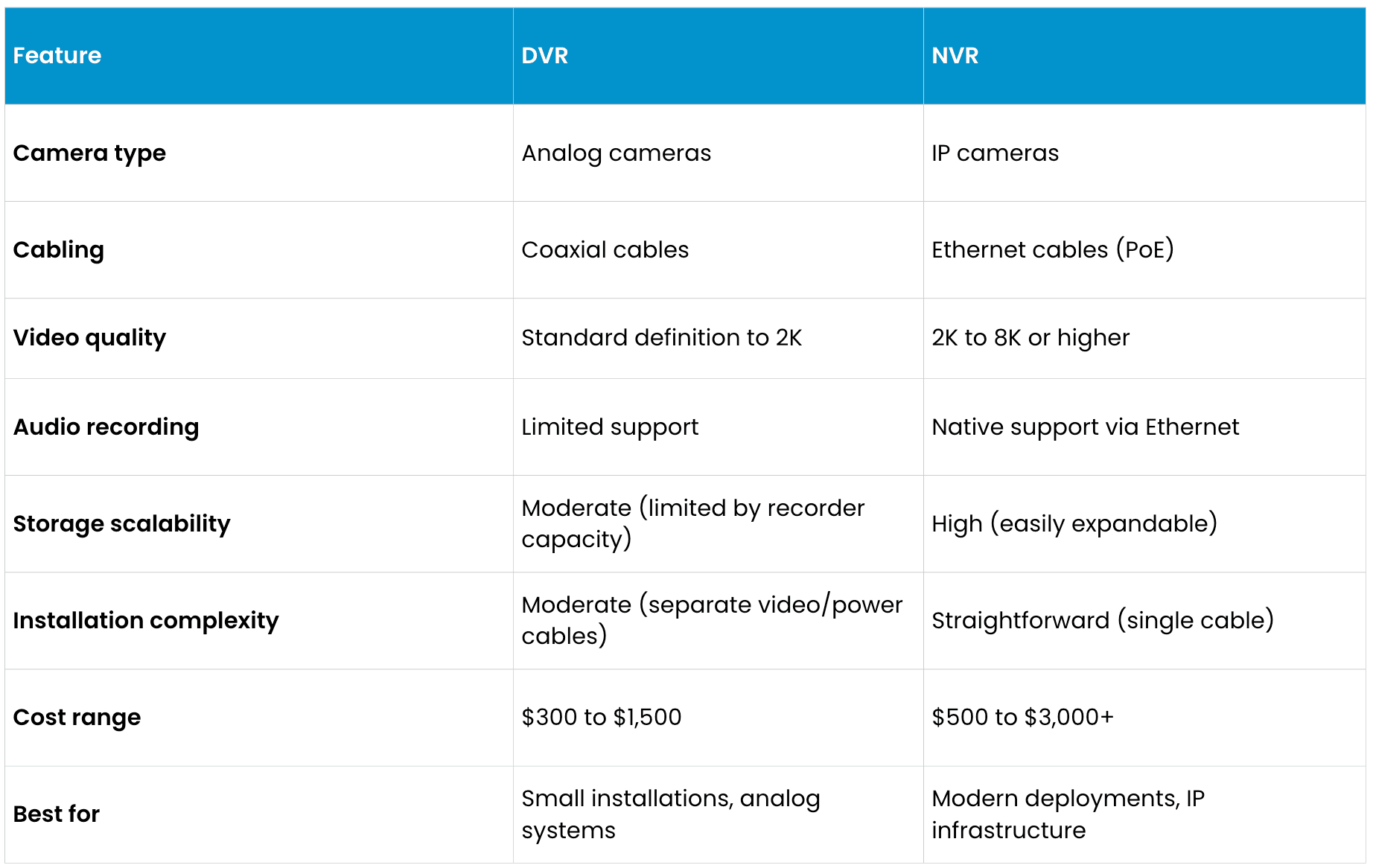
DVR vs. NVR: side-by-side comparison
Camera compatibility
DVR systems work exclusively with analog cameras producing uncompressed signals that the DVR must process. NVR systems require IP cameras with built-in processors for encoding. Some hybrid recorders accept both analog and IP inputs, though this transitional technology is becoming less common.
Video quality and resolution
DVR systems typically output standard definition to 2K resolution, with coaxial cables limited to about 300 feet before signal degradation. NVR systems handle 4K, 5K, 8K and beyond, with Ethernet cables transmitting high-resolution streams over 300+ feet without loss.
Cabling and installation
DVR installations require separate video and power cables to each camera, limiting flexibility. NVR installations use PoE, combining power and data in a single Ethernet cable, reducing installation time, costs, and cable clutter while supporting longer cable runs.
Audio and storage
DVRs require additional cables for audio recording with inferior quality and limited microphone support. NVRs natively support audio through Ethernet transmission alongside video. DVRs are limited to internal storage requiring hardware replacement to expand. NVRs scale easily by adding drives, network storage, or cloud backup without replacing core hardware.
Cost
DVR systems can cost less upfront while NVR systems can cost more initially due to IP cameras and PoE infrastructure, but total cost of ownership over five years may favor NVRs due to reduced maintenance and superior scalability.
When should you choose a DVR over an NVR?
DVRs remain relevant for organizations with extensive existing analog infrastructure or those needing only basic monitoring without advanced analytics, remote viewing, or high-resolution footage. Small retail stores, warehouses without complex monitoring, or legacy systems may justify DVR selection due to lower upfront costs.
When should you choose an NVR over a DVR?
NVR systems are a more modern standard for deployments, offering superior video quality, scalability, and external manageability. Choose NVRs when remote access, mobile viewing, or advanced analytics are requirements. NVRs support AI-powered features like license plate recognition, facial recognition, and behavioral analysis that DVRs cannot provide. If your facility has existing network infrastructure, NVR systems leverage that investment while simplifying camera deployment.
Frequently asked questions about DVR vs. NVR
Can a DVR work with IP cameras?
No. DVRs are designed exclusively for analog cameras. IP cameras encode internally and transmit data over networks using protocols DVRs don't support. Installing IP cameras requires an NVR system. Some hybrid recorders accept both types, but true DVRs cannot process IP video.
Which lasts longer, a DVR or an NVR?
Both typically last 5 to 10 years with proper care. NVRs may have longer practical lifespans because software updates extend functionality without hardware replacement. DVRs may become obsolete faster as the industry transitions to IP-based systems.
Do NVR systems require internet?
NVRs do not require internet for local recording and playback. They operate over local networks independently. Internet access enables remote viewing, cloud backup, mobile alerts, and analytics, but is optional for basic operation.
This content is provided for informational and educational purposes only on an "as-is" basis. The views expressed herein may include speculative claims, represent the opinions of the authors, and do not necessarily reflect the official product specifications or technical capabilities of Verkada products. Verkada makes no guarantees regarding the accuracy, completeness, or timeliness of this content, which may not reflect current legal or industry developments. This post does not constitute legal, technical, or professional advice; any reliance you place on this information is at your own risk. Verkada hereby disclaims all liability for any loss or damage arising from reliance on this content. Readers are solely responsible for their own regulatory compliance and should consult with qualified specialists regarding their specific security and legal requirements.
