Closed-Circuit Television (CCTV) refers to a video monitoring system that transmits video signals over private, dedicated cabling to authorized viewing points within a controlled network. Traditionally using analog cameras and coaxial cables connected to a central Digital Video Recorder (DVR), CCTV systems are now commonly IP-based, but the term persists as a general reference to any video monitoring infrastructure regardless of transmission method.
What is CCTV and how does it work?
CCTV systems capture video from cameras positioned at designated locations and transmit footage to a private network for monitoring and recording. Cameras capture video continuously or on motion triggers, signals travel through dedicated cabling to a DVR or NVR, and authorized operators access live or recorded video through management software.
CCTV vs. IP-based monitoring
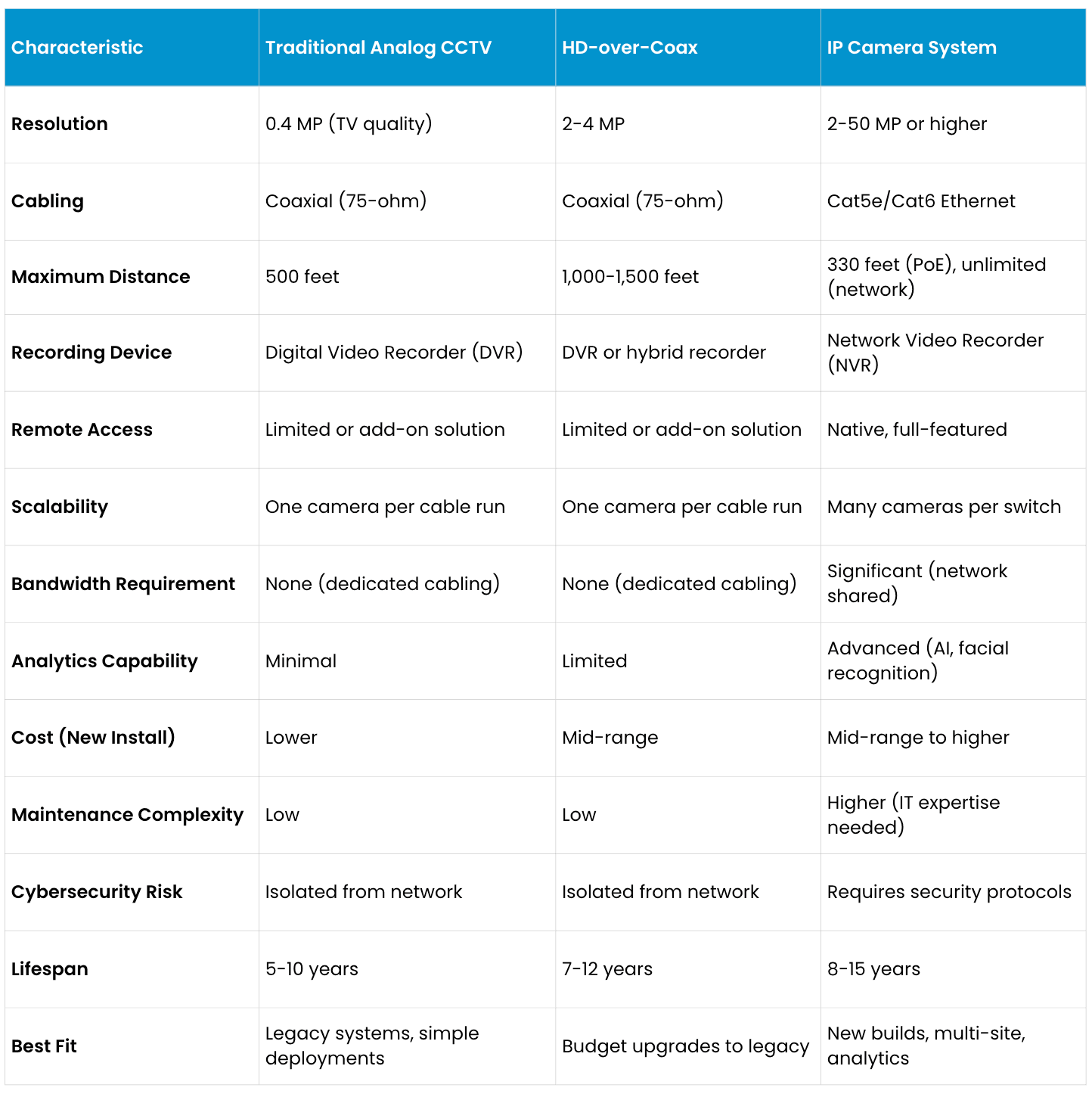
Traditional analog CCTV sends video as continuous electrical signals over coaxial cable, limited to approximately 500 feet without signal degradation. Analog provides approximately 0.4 megapixels maximum.
IP-based monitoring digitizes video at the camera, compresses it using codec algorithms, and transmits digital packets through network infrastructure to an NVR or cloud platform. IP systems support 2MP to 50MP or higher, can transmit over extended distances without signal loss, and enable distributed architecture.
Hybrid systems — HD-over-coax technologies (HD-TVI, HD-CVI, AHD) — use analog cameras that output HD or megapixel video over traditional coaxial cabling, providing a middle path for organizations upgrading from pure analog without replacing all infrastructure.
Components of a CCTV system
Cameras are the sensors — analog, HD-over-coax, or IP models positioned to capture footage from designated areas.
Cabling transmits video signals. Analog systems use 75-ohm coaxial cable; IP systems use Ethernet (Cat5e or Cat6).
A recording facility stores video footage. DVRs serve analog cameras; NVRs serve IP cameras. Recording systems may also store on SAN infrastructure or cloud platforms.
Software and interfaces allow authorized personnel to view live footage, search recorded video, manage camera settings, and review incidents.
Displays provide human visibility — monitors, TVs, or workstations where security personnel monitor or review incidents.
Power supply ensures continuous operation. PoE systems combine power delivery with data in IP installations; analog systems require separate 12VDC power supplies.
What are the different types of CCTV cameras?
CCTV camera technology has evolved through multiple generations, each representing specific transmission and capability paradigms.
Analog CCTV cameras
Analog cameras output a continuous video signal over coaxial cable to a DVR. Resolution is limited to approximately 0.4 megapixels — standard television quality. Analog systems are simple, low-cost, and work independently of computer networks. Transmission distance is limited to approximately 500 feet without signal amplification.
Analog systems remain in operation at many facilities, but new deployments rarely select pure analog due to resolution limitations.
HD-over-coax (HD-TVI, HD-CVI, AHD)
These proprietary technologies send HD or megapixel resolution signals over standard coaxial cabling. HD-TVI (Turbo HD), HD-CVI (Composite HD), and AHD (Analog HD) offer similar capabilities but lack interoperability across brands.
HD-over-coax enables resolution upgrades without replacing existing coaxial cabling infrastructure. Recorders often accept both analog and HD-over-coax inputs, enabling gradual migration. However, cameras and recorders must be matched by manufacturer, and the technology remains inferior to IP systems in long-distance transmission and scalability.
IP-based CCTV systems
IP cameras transmit digitized, compressed video over standard network infrastructure to NVRs or cloud platforms. Resolution usually ranges from 2MP to 50MP+, far exceeding analog and HD-over-coax alternatives. IP systems can also support sophisticated features including built-in analytics, motion detection, and facial recognition.
IP CCTV represents the modern monitoring standard. Organizations can leverage existing network infrastructure, deploy cameras as standard network devices, and access video from any location with network connectivity. Cloud-based IP systems enable rapid scaling from single-site to multi-site deployments. However, IP systems usually require network expertise, present cybersecurity considerations, and consume network bandwidth proportional to camera count and resolution.
CCTV vs. IP cameras: which is better?
CCTV Applications
Retail and loss prevention: Retail facilities may use CCTV to monitor sales floors and point-of-sale areas. High-quality video enables identification of customers and merchandise movement.
Banks and financial institutions: Banks may deploy CCTV for vault protection and fraud investigation. Regulatory compliance mandates comprehensive video coverage.
Public spaces and transportation: Airports, transit stations, and public transportation systems may use CCTV for crowd management and investigation.
Residential properties: Homeowners increasingly deploy residential CCTV systems to monitor property perimeters and entry points.
Limitations of traditional CCTV
Resolution limitations prevent detailed identification. Analog systems cannot zoom effectively. At 0.4 megapixels, license plates and facial features can become illegible.
Scalability challenges arise with traditional architectures. Adding cameras requires running new coaxial cable runs. Multi-site deployments require separate recording facilities at each location.
Lack of intelligent analytics is inherent to analog systems. Motion detection is basic; advanced features like facial recognition or unusual-behavior alerts are impossible.
Limited remote access means personnel must physically visit the recording location to review footage. Adding remote access requires specialized equipment and networking expertise.
Bandwidth isolation in coaxial-based systems means infrastructure cannot support high-resolution transmission or multi-site consolidation.
Is CCTV being replaced by IP and cloud-based systems?
IP camera systems and cloud-based monitoring platforms are replacing traditional CCTV, driven by superior image quality, scalability, and remote access. However, replacement is gradual. Organizations with legacy systems often lack budget justification for wholesale replacement when existing hardware continues recording, and gradual migration strategies are common.
Regulatory and compliance drivers accelerate migration in regulated industries where forensic-quality video retention is mandated. New installations overwhelmingly choose IP systems over analog CCTV.
Frequently asked questions
What does CCTV stand for?
CCTV stands for Closed-Circuit Television. The term refers to video monitoring systems that transmit signals through private, controlled networks accessible only to authorized users.
Is CCTV the same as IP cameras?
Not technically. Traditional CCTV uses coaxial cable and DVR recording. IP cameras use network transmission and NVR recording. Modern usage often applies "CCTV" generically to any video monitoring system.
How long is footage typically kept?
Retention policies vary by application and regulation and can run anywhere from 30 to 365+ days.
Can CCTV systems connect to the internet?
Traditional analog CCTV systems are isolated from the internet by design. Modern IP-based CCTV systems support internet connectivity, enabling remote viewing and cloud backup.
What is the difference between a DVR and an NVR?
DVRs serve analog cameras. NVRs serve IP cameras. NVRs are more flexible, supporting unlimited cameras compared to DVRs typically limited to 4, 8, or 16 camera inputs.
This content is provided for informational and educational purposes only on an "as-is" basis. The views expressed herein may include speculative claims, represent the opinions of the authors, and do not necessarily reflect the official product specifications or technical capabilities of Verkada products. Verkada makes no guarantees regarding the accuracy, completeness, or timeliness of this content, which may not reflect current legal or industry developments. This post does not constitute legal, technical, or professional advice; any reliance you place on this information is at your own risk. Verkada hereby disclaims all liability for any loss or damage arising from reliance on this content. Readers are solely responsible for their own regulatory compliance and should consult with qualified specialists regarding their specific security and legal requirements.
