A fisheye camera is a security camera equipped with an ultra-wide-angle lens that captures up to 180 to 360-degree panoramic views in a single unit. Using specialized dewarping technology, the distorted fisheye image converts to normal-looking views that operators can pan, tilt, and zoom digitally. Fisheye cameras provide exceptional coverage efficiency — monitoring entire rooms with one unit instead of three or four traditional cameras — while reducing blind spots and reducing installation complexity.
What is a fisheye camera and how does it work?
Fisheye cameras use extreme wide-angle lenses (180-360 degrees) capturing panoramic views but with severe barrel warping. Dewarping software mathematically corrects this distortion in real time or playback, dividing curved images into virtual regions and mapping to normal perspective. After dewarping, operators can view up to 360-degree coverage with digital zoom and pan capability.
Fisheye lenses use special optical designs with extreme curvature capturing all directions simultaneously — above, below, left, right, all diagonals. Large-format sensors (12-20 megapixels) capture sufficient detail across the massive field of view, helping to ensure zoomed views maintain usable detail.
Two dewarping approaches: Hardware dewarping occurs in the camera, transmitting multiple pre-corrected outputs (consuming 3-4 NVR channels). Software dewarping keeps raw fisheye images and applies corrections in the NVR/VMS, consuming one channel but requiring more CPU and providing greater flexibility. Software dewarping allows operators to change views during playback, zoom different areas, or adjust digital pan-tilt-zoom independently. Modern 3D correction algorithms account for lens geometry, sensor characteristics, and optical properties, producing images nearly indistinguishable from traditional cameras but with panoramic coverage.
What are the advantages of fisheye security cameras?
Full-room coverage: A single fisheye accomplishes what three to five traditional cameras cover, dramatically reducing hardware costs, cabling, and system complexity. Installation involves one ceiling-mounted device rather than running conduit to multiple wall locations.
No blind spots or moving parts: Stationary fisheye cameras observe entire spaces permanently without motors or mechanical parts prone to failure. Digital movement eliminates mechanical wear and maintenance. 360-degree capture means no gaps — fisheye cameras observe everything in view, providing comprehensive incident documentation and eliminating monitoring blindness.
Digital PTZ without mechanical wear: Fisheye provides pan, tilt, zoom entirely through software. During playback, operators digitally navigate recorded scenes with full resolution and detail. No mechanical failure is possible. Live viewing supports real-time digital PTZ, with multiple operators simultaneously viewing different regions of the same camera — impossible with mechanical PTZ that can only point one direction.
Fisheye vs. PTZ vs. fixed cameras: which should you choose?
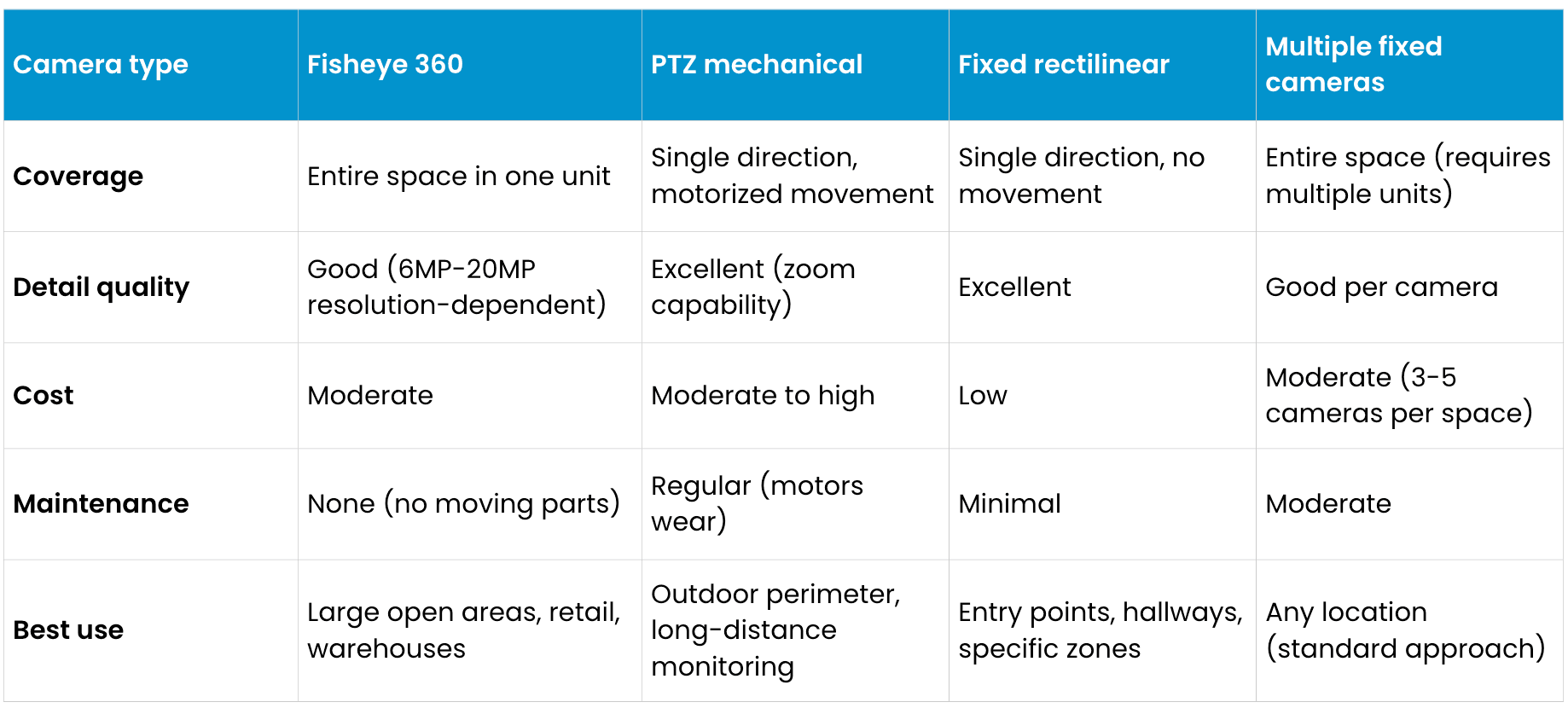
Fisheye cameras excel in large indoor spaces. Retail stores, warehouses, manufacturing floors, and office buildings benefit from single-unit comprehensive coverage. PTZ cameras work best for outdoor applications and long-distance monitoring where detail at range is paramount. Fixed narrow-angle cameras remain optimal for specific-purpose applications like entrance monitoring or hallway coverage.
Where are fisheye cameras most effective?
Retail stores and lobbies: Loss prevention teams can use fisheyes to monitor entire store sections from the ceiling. A single unit can observe a wide range of customer and employee activity in departments without moving parts, using digital pan-tilt-zoom for suspicious activity examination. Lobbies and public spaces benefit similarly, with one camera documenting everyone entering, waiting, and at reception with perfect coverage continuity.
Warehouses and open floor plans: Distribution centers and manufacturing use fisheye for area monitoring, observing pallet movements, equipment, and personnel across thousands of square feet with high resolution (12-20MP) for identifying specific activities anywhere. Office open floor plans use fisheye efficiently, covering large bullpen areas, conference spaces, and common areas better than traditional multiple-camera approaches.
Conference rooms and offices: A single ceiling-mounted fisheye replaces traditional wall-mounted cameras in meeting rooms, conference centers, and small-medium offices, capturing everyone without awkward intrusive positioning. Dewarping provides normal-looking views suitable for professional environments.
Limitations
Extreme wide angles sacrifice zoom range — distant subjects appear tiny even at full zoom. Identifying license plates across parking lots strains fisheye capability compared to telephoto bullets. Dewarping quality depends on resolution — lower-resolution (under 6MP) produces grainy zoomed images. High-quality usually requires 12MP+ resolution costing more than entry-level fixed cameras. Real-time software dewarping requires powerful NVR hardware. Installation needs relatively open, centered ceiling positions; wall or off-center positioning creates inefficient coverage. Outdoor fisheye face environmental limitations — dome housing reduces field of view and weather may affect ultra-wide lenses more than traditional optics.
Frequently asked questions
What resolution do fisheye cameras provide?
Common fisheye cameras range from 5MP to 20MP. Higher resolution provides better detail when zooming. A 12MP fisheye generally provides adequate resolution for retail loss prevention and warehouse monitoring. Extreme long-distance identification (license plates 200+ feet) performs better with traditional telephoto cameras regardless of resolution.
Can fisheye cameras see in the dark?
Fisheye cameras include infrared (IR) illumination. The extreme wide angle spreads IR across larger areas, potentially reducing near-IR effectiveness compared to narrow-angle cameras. Verify infrared specifications for low-light applications.
Is dewarping included with all fisheye cameras?
Some older video management systems lack dewarping support, requiring updated software. Verify your existing VMS supports dewarping or plan to upgrade.
Can fisheye cameras be used outdoors?
Yes, weatherproof IP66/IP67 models can work well outdoors. However, protective dome housing reduces effective field of view. Performance is excellent in covered areas (eaves, parking garage ceilings) but less impressive in open-air mounting. Traditional bullet or turret cameras often provide better pure outdoor results.
This content is provided for informational and educational purposes only on an "as-is" basis. The views expressed herein may include speculative claims, represent the opinions of the authors, and do not necessarily reflect the official product specifications or technical capabilities of Verkada products. Verkada makes no guarantees regarding the accuracy, completeness, or timeliness of this content, which may not reflect current legal or industry developments. This post does not constitute legal, technical, or professional advice; any reliance you place on this information is at your own risk. Verkada hereby disclaims all liability for any loss or damage arising from reliance on this content. Readers are solely responsible for their own regulatory compliance and should consult with qualified specialists regarding their specific security and legal requirements.
