Power over Ethernet (PoE) cameras receive both electrical power and data transmission through a single Ethernet cable, reducing the need for separate power supplies and electrical wiring in many configurations. PoE technology is designed to streamline installation by reducing cable count, and providing wider camera placement flexibility. Network infrastructure supplies power through specialized switches or injectors that add direct current (DC) electrical energy to data signal transmission, allowing Ethernet cables to deliver both power and network connectivity simultaneously.
What is a PoE camera and how does it work?
PoE cameras function identically to traditional IP cameras regarding video functionality but do not require separate power cables. The fundamental innovation involves injecting electrical power into standard Ethernet cabling without disrupting data transmission. Ethernet cables contain four twisted pair conductors — data transmission uses two pairs while power injection uses the remaining pairs (or shares existing pairs with proper isolation).
At the installation point, a Power Sourcing Equipment (PSE) device — either a PoE switch or PoE injector — adds DC electrical voltage to the Ethernet cable. As the cable carries electricity to the camera, a Powered Device (PD) inside the camera rectifies the electrical current and supplies power to camera components. The Powered Device negotiates power requirements through Power Data Object (PDO) signaling, communicating how much power it requires.
This approach helps enable substantial installation simplification. Traditional systems require separate electrical circuits, outlet installation, and power cable routing to every camera location. PoE minimizes these expenses by consolidating power and network connectivity into single cable runs.
How Power over Ethernet delivers power and data
Data transmission over Ethernet cables uses frequencies in the megahertz range. Power transmission uses direct current at much lower frequencies. Isolation transformers within Powered Devices separate these signals, allowing simultaneous transmission without interference.
Power transmission occurs over standard Cat5e and Cat6 Ethernet cables at distances up to 100 meters (330 feet). Longer cable runs experience voltage drop that gradually reduces power delivery. Proper cable selection and careful power budgeting help prevent voltage drop problems.
Network switches with integrated PoE capability contain Power Sourcing Equipment that monitors each port and supplies power based on specific requirements. PoE injectors offer an alternative for retrofitting existing network infrastructure, connecting between standard network switches and cables. Injectors tend to be less expensive than PoE switches but cannot be centrally managed as effectively.
PoE standards
IEEE 802.3af (PoE) delivers maximum 15.4 watts per port, with approximately 12.95 watts available at the device. This standard may suit basic cameras without heating or advanced processing. Most entry-level IP cameras may operate at 3 to 10 watts.
IEEE 802.3at (PoE+) increases maximum power to 30 watts per port, with approximately 25 watts available at the device. PoE+ supports cameras with pan-tilt-zoom motors, infrared illumination, or advanced processing. Professional security deployments frequently specify PoE+.
IEEE 802.3bt (PoE++) introduces Type 3 and Type 4 standards. Type 3 delivers 60 watts maximum (approximately 51 watts guaranteed). Type 4 delivers 90 watts maximum (approximately 71.3 watts guaranteed). These standards support extreme-power applications.
All standards maintain backward compatibility. However, power-intensive devices may not function properly on lower-standard infrastructure.
Advantages of PoE cameras
Single-cable installation
Installation technicians route one Ethernet cable to each camera rather than separate power and network cables. By consolidating power and data, organizations can often reduce the total amount of cabling and labor required for a new deployment.
Centralized power management
PoE switches support centralized power monitoring and management. System administrators can often observe power consumption at each port and remotely power cycle devices. Power budgeting becomes more transparent for system expansion planning.
Longer cable runs (up to 100 meters)
Standard Ethernet cabling supports runs to 100 meters without signal degradation. This capability provides flexibility in camera placement without requiring additional infrastructure.
What do you need to set up a PoE camera system?
PoE switch or PoE injector
PoE switches contain integrated Power Sourcing Equipment delivering power to each port. Enterprise-grade PoE switches vary in price based on port density, power budget, and management features.
PoE injectors are smaller and tend to be less expensive devices that retrofit into existing network infrastructure.
Cat5e or Cat6 Ethernet cable
Standard Ethernet cabling works for PoE if properly selected. Cat5e supports PoE+ standard requirements. Cat6 tends to provide better performance and supports PoE++ standards.
Cable quality affects power delivery efficiency. Higher-quality cables can minimize voltage drop over long distances. Outdoor installations may require weatherproof cabling certified for outdoor use.
NVR or cloud-based recording
PoE cameras require network video recorders or cloud-based recording platforms to store footage. Recording system selection is independent of PoE adoption.
PoE vs. WiFi vs. traditional power
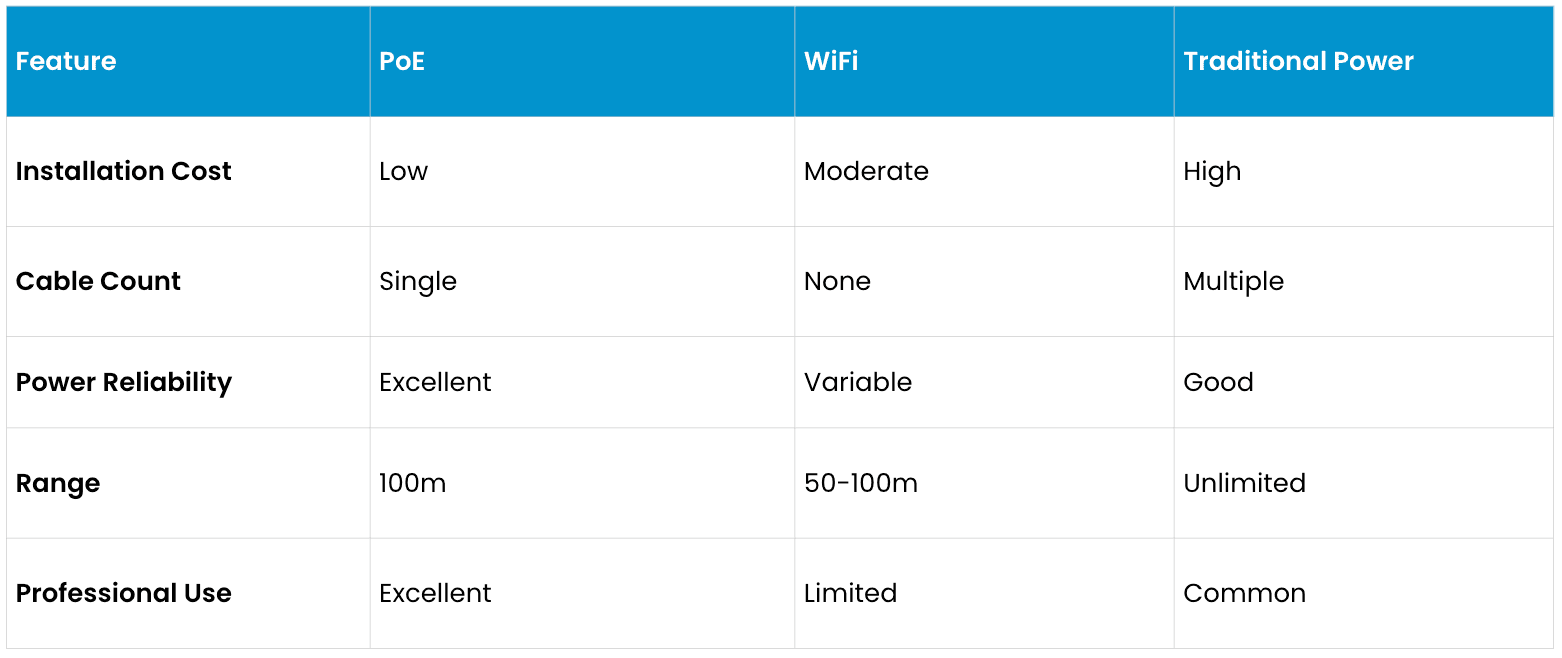
PoE balances cost-effectiveness, reliability, and professional capability. WiFi offers maximum flexibility but suffers from interference and power limitations. Traditional power generally offers unlimited range but requires extensive infrastructure.
WiFi cameras suit temporary installations or small deployments where cabling is impossible. However, WiFi's unreliability makes it unsuitable for critical security applications.
Traditional power remains appropriate for facilities with existing substantial electrical infrastructure. However, new installations rarely justify the additional cost and complexity.
Frequently asked questions
Can I mix PoE and non-PoE cameras on the same switch?
PoE switches include standard network ports alongside PoE-enabled ports. However, most professional installations standardize on all-PoE or all-non-PoE approaches to simplify management.
How much power does a typical PoE camera consume?
Standard IP cameras may consume 3 to 10 watts at normal operation. Cameras with infrared illumination and pan-tilt-zoom motors may consume 10 to 30 watts. Extreme-power cameras may exceed 30 watts. Organizations may want to consult camera specifications before purchasing PoE infrastructure.
Can I use PoE+ cameras on 802.3af switches?
PoE+ cameras are designed for the higher power budgets that 802.3af equipment may not be specified to provide. Cameras may partially function on reduced power but likely will not perform optimally.
What's the maximum distance I can run PoE cables?
Standard 100-meter Ethernet cable maximum applies to PoE. At 100 meters with power-intensive cameras, voltage drop may prevent proper operation.
Do I need special cables for PoE?
Standard Cat5e or Cat6 cabling works for PoE if properly installed. Cable quality affects voltage drop over distance.
Can I power a PoE camera with a standard electrical outlet?
PoE injectors work only with Ethernet cables, not standard electrical outlets.
What happens if PoE power exceeds switch capacity?
Modern switches can disable power to ports when total demand exceeds capacity. Proper capacity planning helps ensure cumulative camera power consumption remains within switch specifications.
Are there safety concerns with PoE?
PoE operates at low voltage (48 volts DC) and low current, making it inherently safer than traditional electrical power. Properly designed PoE systems pose minimal shock hazard.
Can I use PoE in hazardous environments?
PoE operates at low voltage and power levels, which differs from the safety profile of traditional high-voltage electrical power. While PoE is a low-voltage standard, users should always follow local electrical codes and manufacturer safety guidelines during installation.
Does PoE work outdoors?
PoE generally works equally well in outdoor installations with appropriate weatherproof cabling and connector protection.
Can PoE cameras be upgraded to higher-power versions?
Upgrading from standard PoE to PoE+ usually requires switch replacement. Organizations can plan infrastructure to accommodate future camera upgrades by initially installing PoE+ switches.
This content is provided for informational and educational purposes only on an "as-is" basis. The views expressed herein may include speculative claims, represent the opinions of the authors, and do not necessarily reflect the official product specifications or technical capabilities of Verkada products. Verkada makes no guarantees regarding the accuracy, completeness, or timeliness of this content, which may not reflect current legal or industry developments. This post does not constitute legal, technical, or professional advice; any reliance you place on this information is at your own risk. Verkada hereby disclaims all liability for any loss or damage arising from reliance on this content. Readers are solely responsible for their own regulatory compliance and should consult with qualified specialists regarding their specific security and legal requirements.
